Infinite Solutions Applicable and Applied

Engineering, data, cloud, regulated systems, and applied AI solutions focused on real outcomes.

I don't manage six AI engineers. I trained them until I could manage their Managing Director.

Marc Alexander — Accountable Operator
How I work with AI →

What We Ship

Production systems, not capability statements.

Running in production

Autonomous Engineering System

A production system that researches opportunities, defines specifications, generates software and content, evaluates results, repairs failures, verifies acceptance criteria, deploys approved work, and monitors what it releases — without a person approving each release.

How it works
  • Specification-driven — requirements, constraints, acceptance criteria, and release conditions exist before generated work can become production work.
  • Deterministic release gates — generated artifacts must pass structural, behavioral, build, test, security, and deployment controls before release.
  • Durable execution — execution state survives failures. Work can retry, resume, repair, or terminate explicitly without losing its history.
  • Bounded authority — AI can research, create, evaluate, diagnose, and repair. It cannot weaken its own controls or independently grant itself production authority.
  • Evidence by default — decisions, evaluations, releases, failures, and interventions produce retained evidence.

Live production

Live evidence — SmartTools and ToolDocs are production surfaces produced and maintained by this system.

76 SmartTools live 85 ToolDocs live established May 2, 2026 last published September 3, 2026
AI Document Assistant

Ask anything about your documents.

Available now

Private-document retrieval designed around the controls required to make AI useful inside an organization.

What it does
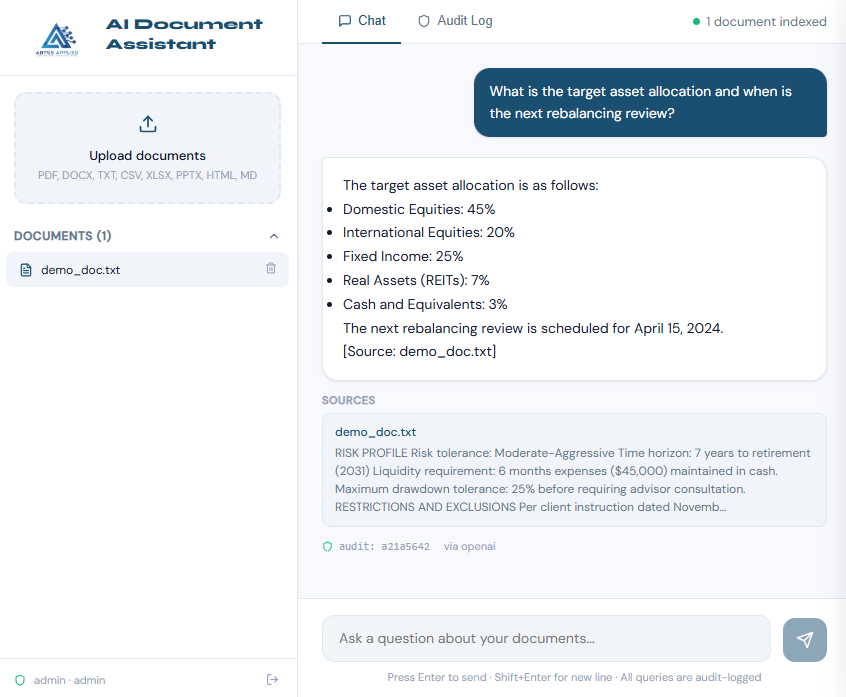
  • Source-cited answers — responses trace back to the documents supporting them.
  • Private retrieval — documents remain inside the client's controlled environment.
  • Role-based access — users retrieve only information they are authorized to access.
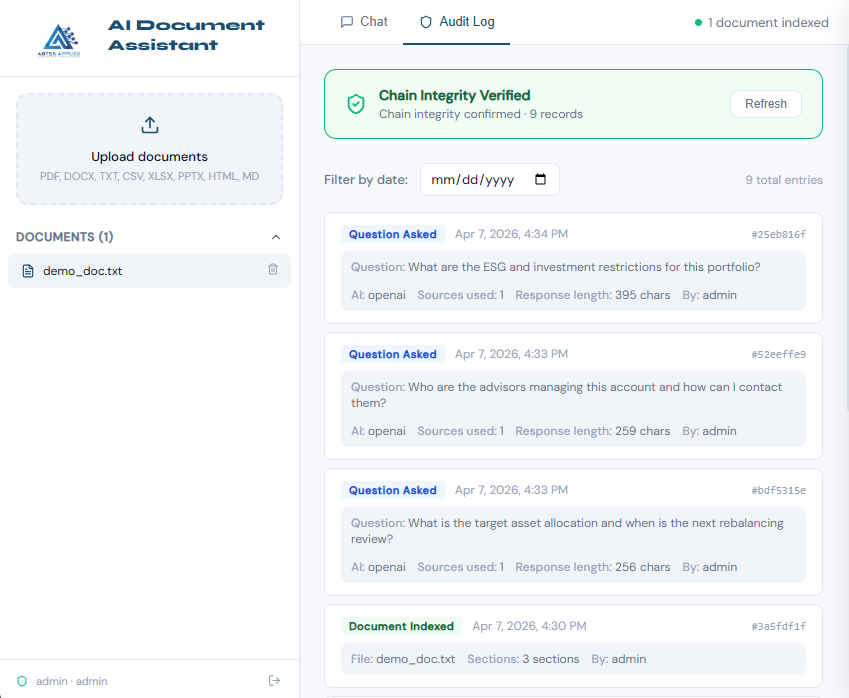
  • Tamper-evident audit — queries and responses produce SHA-256 hash-chained audit history.
  • Model-agnostic — the application targets a provider interface, not a vendor. Anthropic and OpenAI are supported, and a self-hosted model can serve environments where inference must stay inside your boundary.
  • Delivered in your environment — architecture and implementation fit your stack and compliance boundary rather than forcing a preferred one.
  • Controlled delivery — authentication, authorization, testing, CI gates, audit evidence, and deployment controls are part of the system.
AI Document Assistant chat interface showing a source-cited answer
Source-cited chat
AI Document Assistant audit log with tamper-evident, hash-chained entries
Tamper-evident audit log

How We Engineer

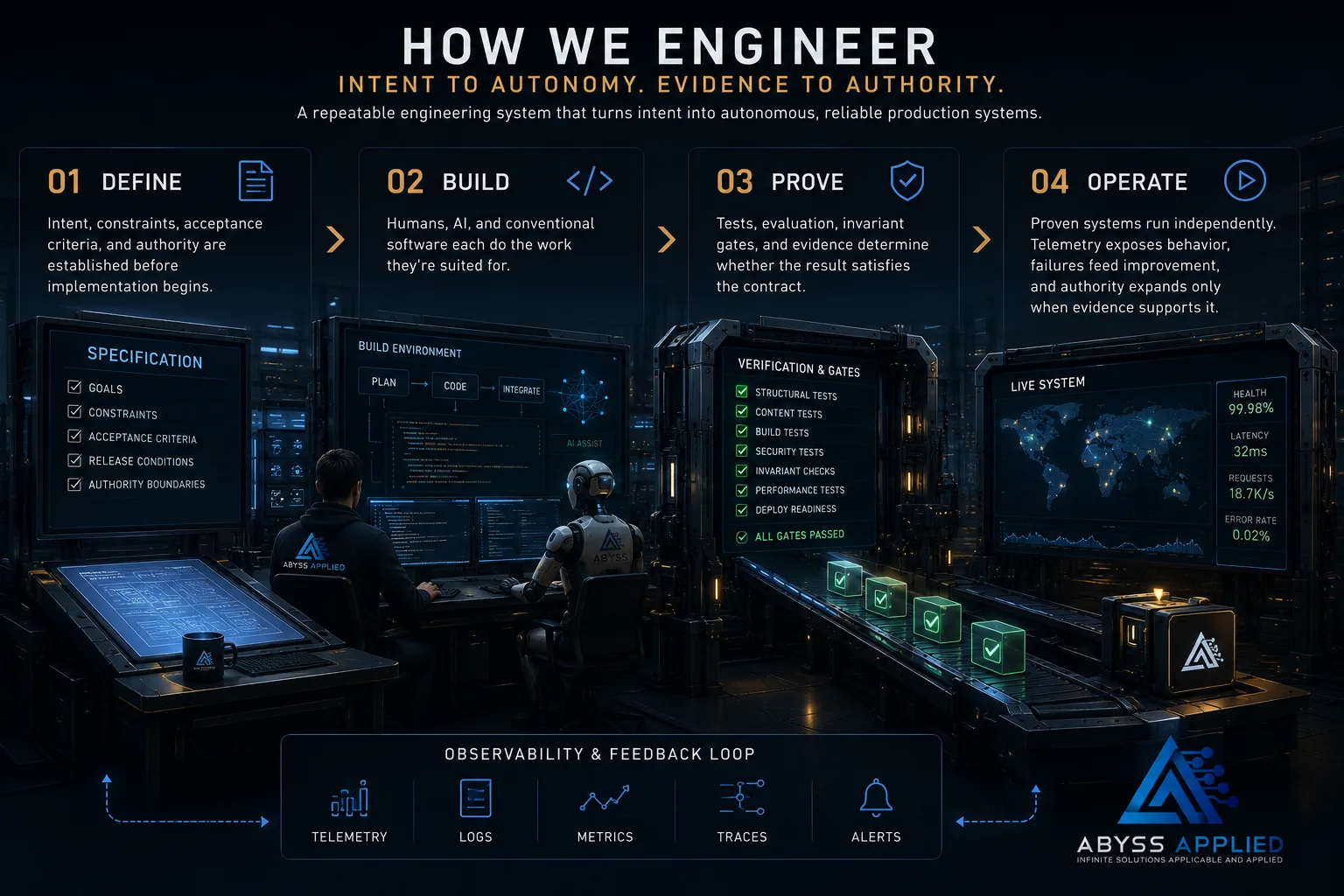
We define what must be true, build against that contract, prove the implementation satisfies it, and operate what has earned the right to run.

Intent to autonomy. Evidence to authority.

  1. Define
  2. Build
  3. Prove
  4. Operate
  • Define — Intent, constraints, acceptance criteria, and authority are established before implementation begins.
  • Build — Humans, AI, and conventional software each do the work they're suited for.
  • Prove — Tests, evaluation, invariant gates, and evidence determine whether the result satisfies the contract.
  • Operate — Proven systems run independently. Telemetry exposes behavior, failures feed improvement, and authority expands only when evidence supports it.
Four stations — define, build, prove, operate — showing a specification board, a human and an AI engineer building side by side, a verification gate panel, and a live system map.

Evidence — not appearance — determines when the work is finished.

What We Do

Different domains. Same engineering discipline.

Software & Systems

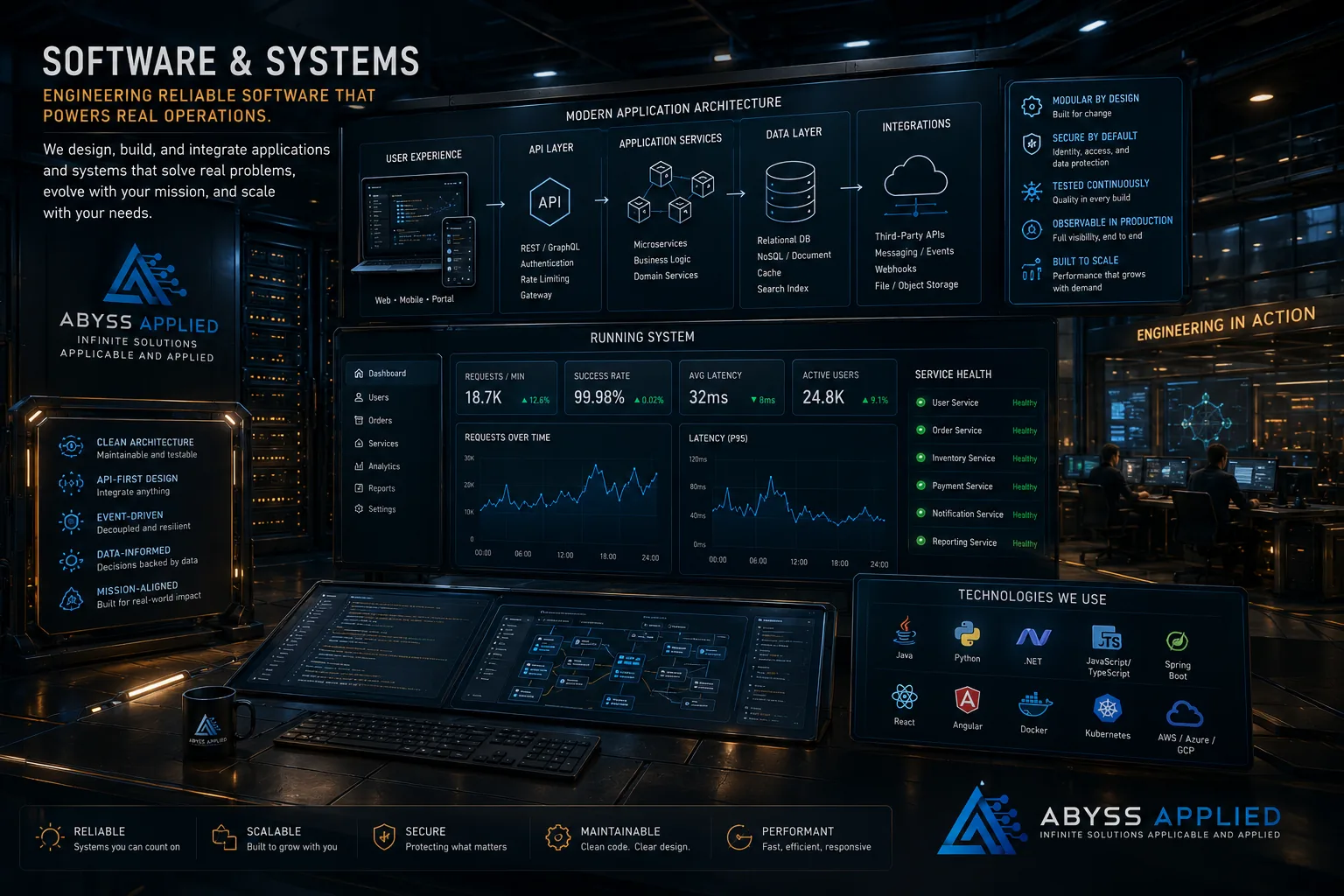
Modern applications engineered as complete systems.

Interfaces, APIs, services, integration, persistence, deployment, and runtime behavior designed together around the problem—not constrained by a preferred language or framework.

Application architecture board showing user experience, API layer, application services, data layer and integrations, beside a running system dashboard.

Data & Analytics

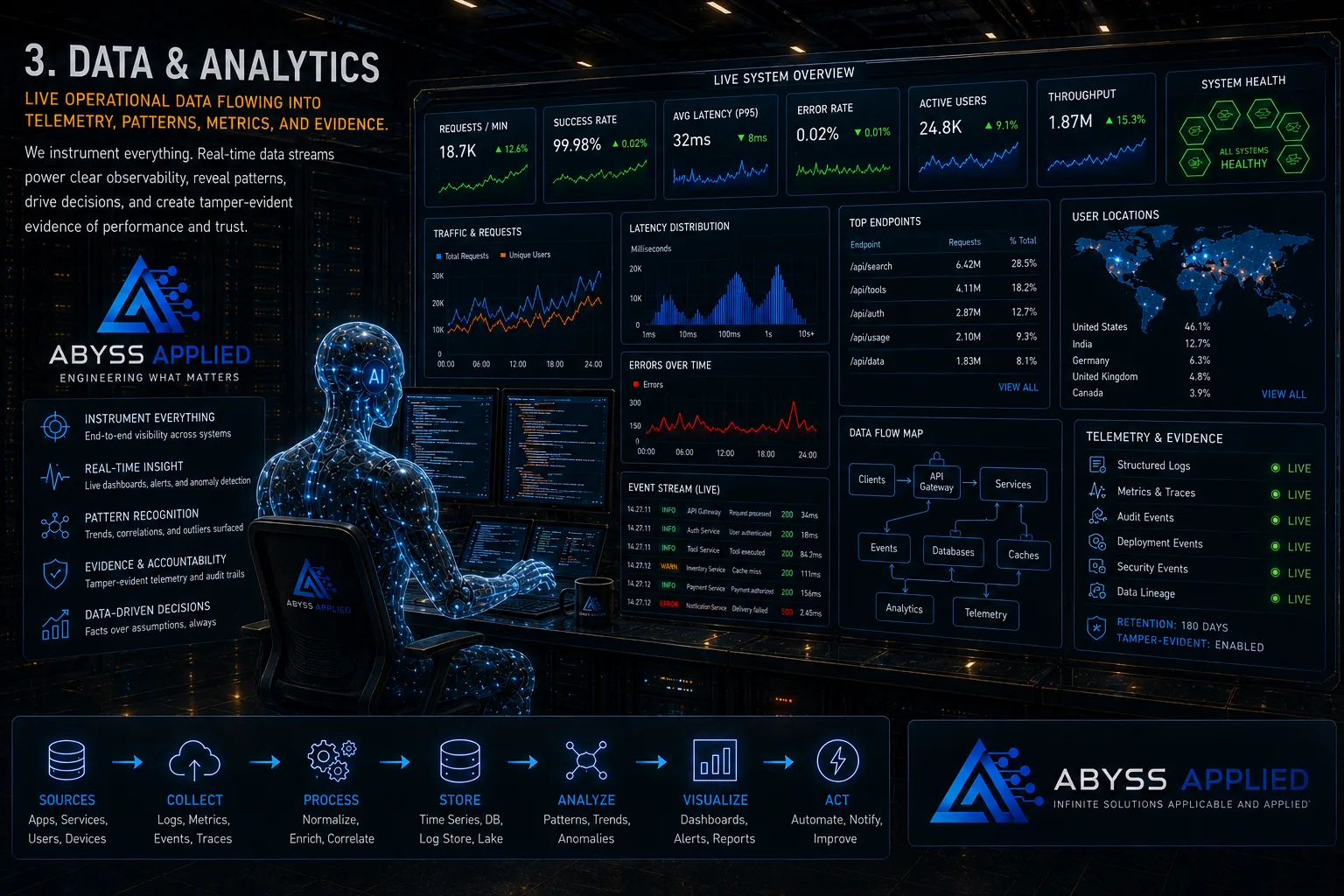
Operational data becomes observable behavior.

Live operational data flows into telemetry, patterns, metrics, and evidence—making system behavior measurable and giving engineering decisions something concrete to act on.

A wall of live telemetry — request rate, latency distribution, error trend, event stream and data flow map — watched by a translucent figure of light.
  1. Sources
  2. Collect
  3. Process
  4. Store
  5. Analyze
  6. Visualize
  7. Act

Observe first. Improve what the evidence reveals.

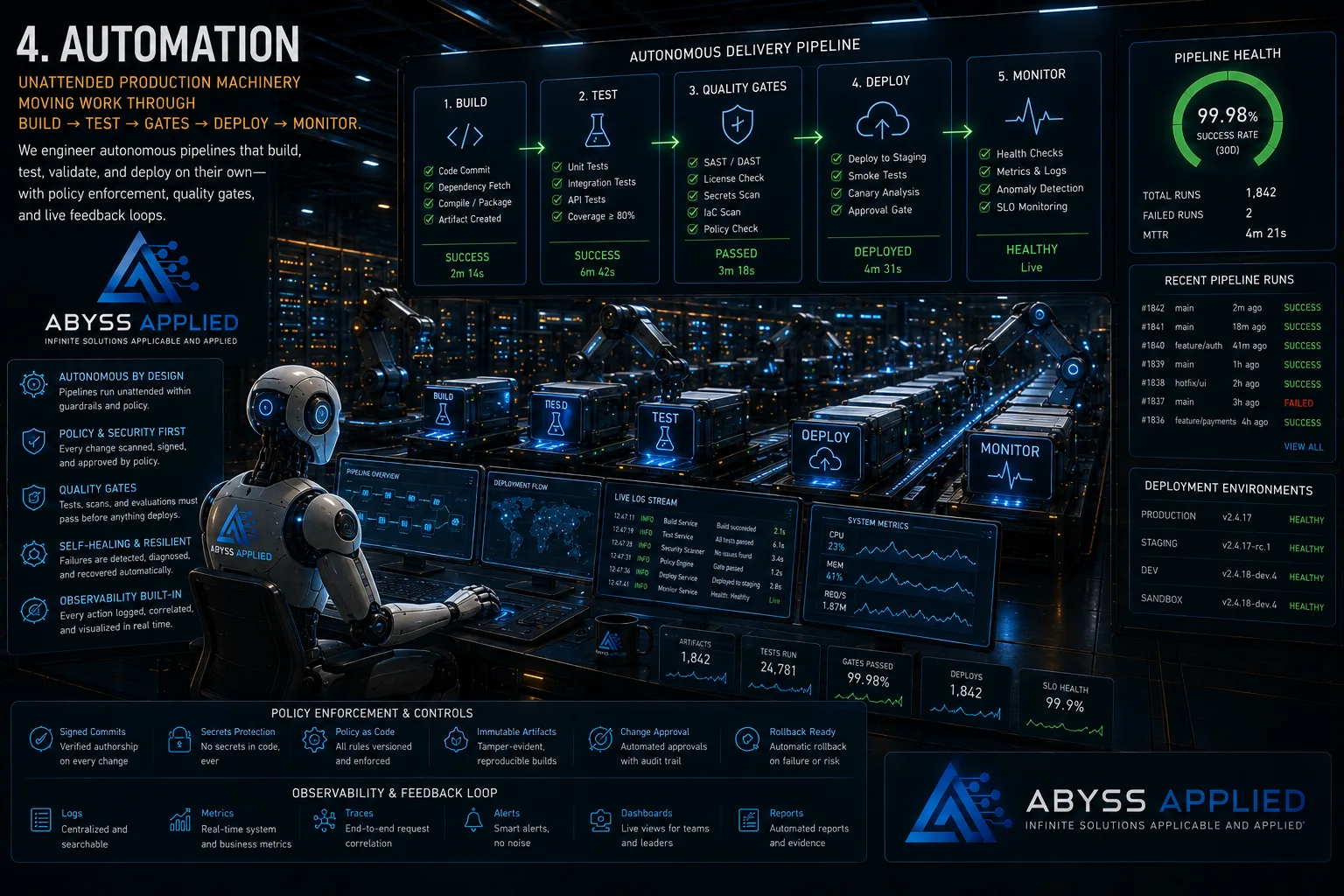
Automation

Proven work should not require someone watching it.

Automation begins when a process has been defined, constrained, and proven well enough to execute reliably without a person occupying the execution path.

An autonomous delivery pipeline running unattended: build, test, quality gates, deploy and monitor stages each reporting their own result.

Once proven, it runs.

See what it produces → SmartTools

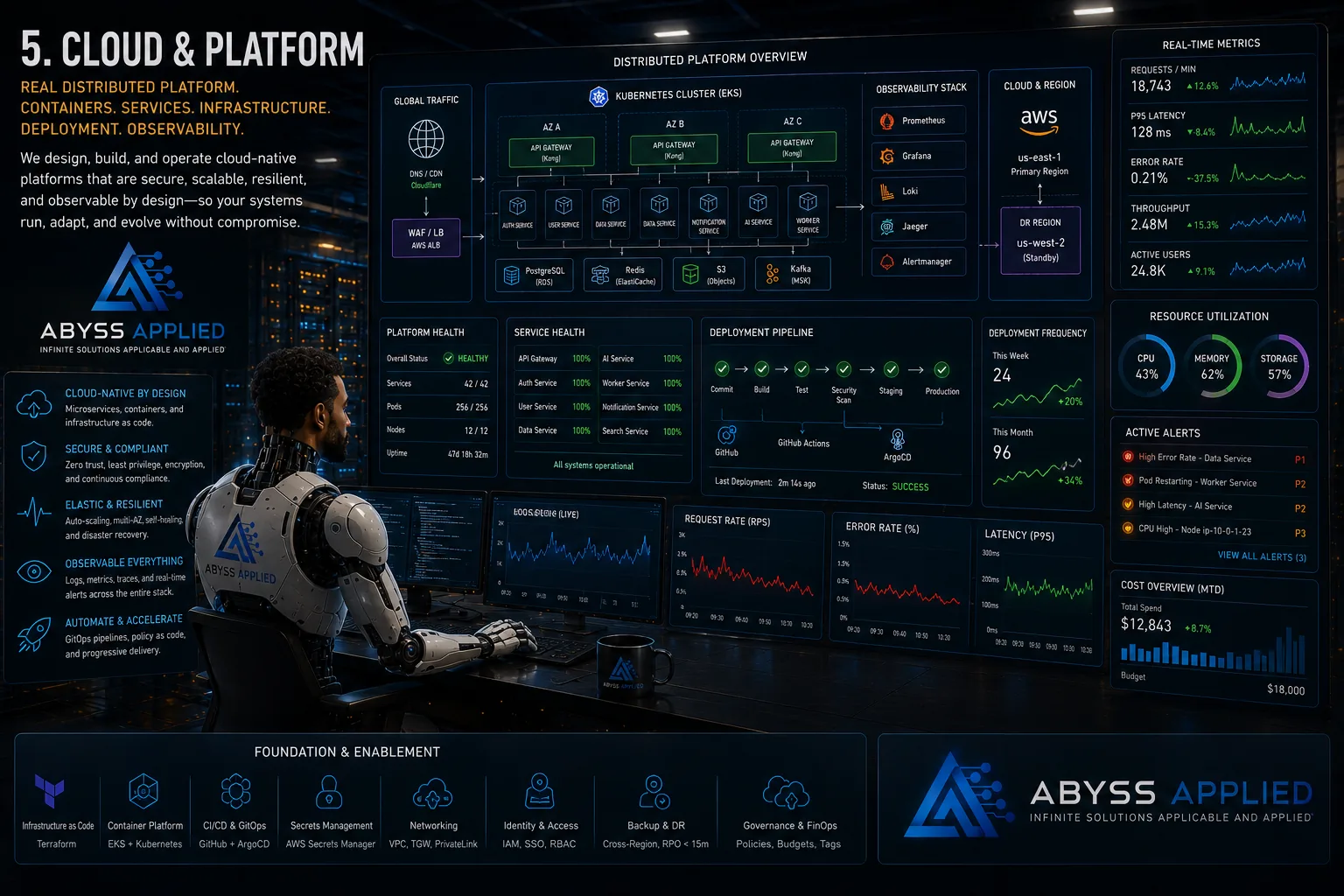
Cloud & Platform

Systems need a predictable place to run.

Applications, services, infrastructure, deployment, resilience, security, and observability are engineered as parts of the same operating platform.

A distributed platform overview — global traffic, a multi-zone cluster, an observability stack and a standby region — with platform and service health alongside.

Build the application. Engineer the environment around it.

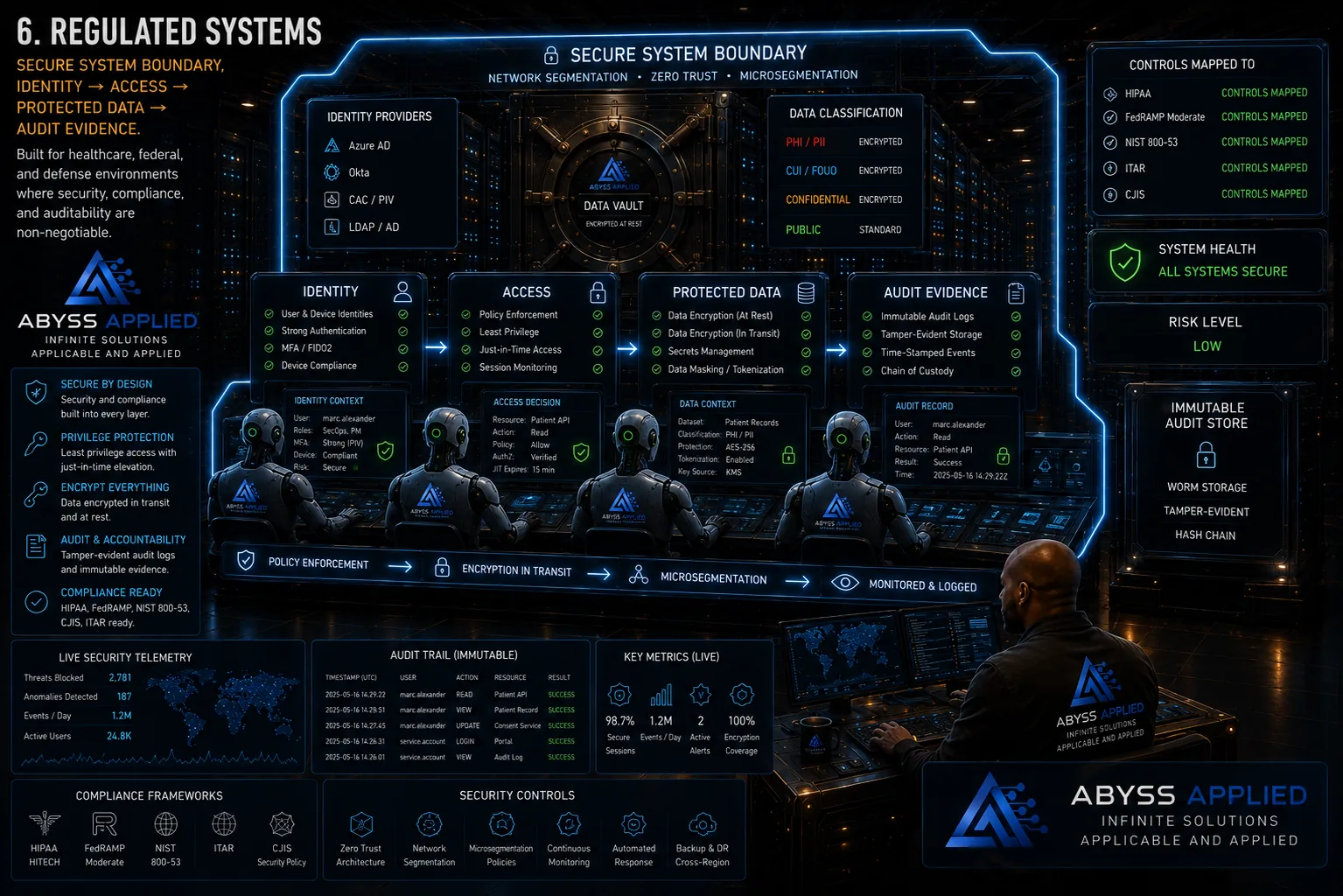
Regulated Systems

When security, accountability, and evidence are non-negotiable.

Controlled environments require more than functional software. Identity, authorization, protected information, policy enforcement, traceability, and retained evidence belong inside the system architecture.

A secure system boundary diagram running identity, access, protected data and audit evidence, with data classification, an immutable audit store and a control-mapping panel.
  1. Identity
  2. Access
  3. Protected Data
  4. Audit Evidence

Strong authentication · Least privilege · Policy enforcement · Encryption · Data classification · Microsegmentation · Continuous monitoring · Immutable audit evidence · WORM storage

Applicable to healthcare, federal, defense, intelligence, and other controlled environments.

Security and compliance are built into the system boundary.

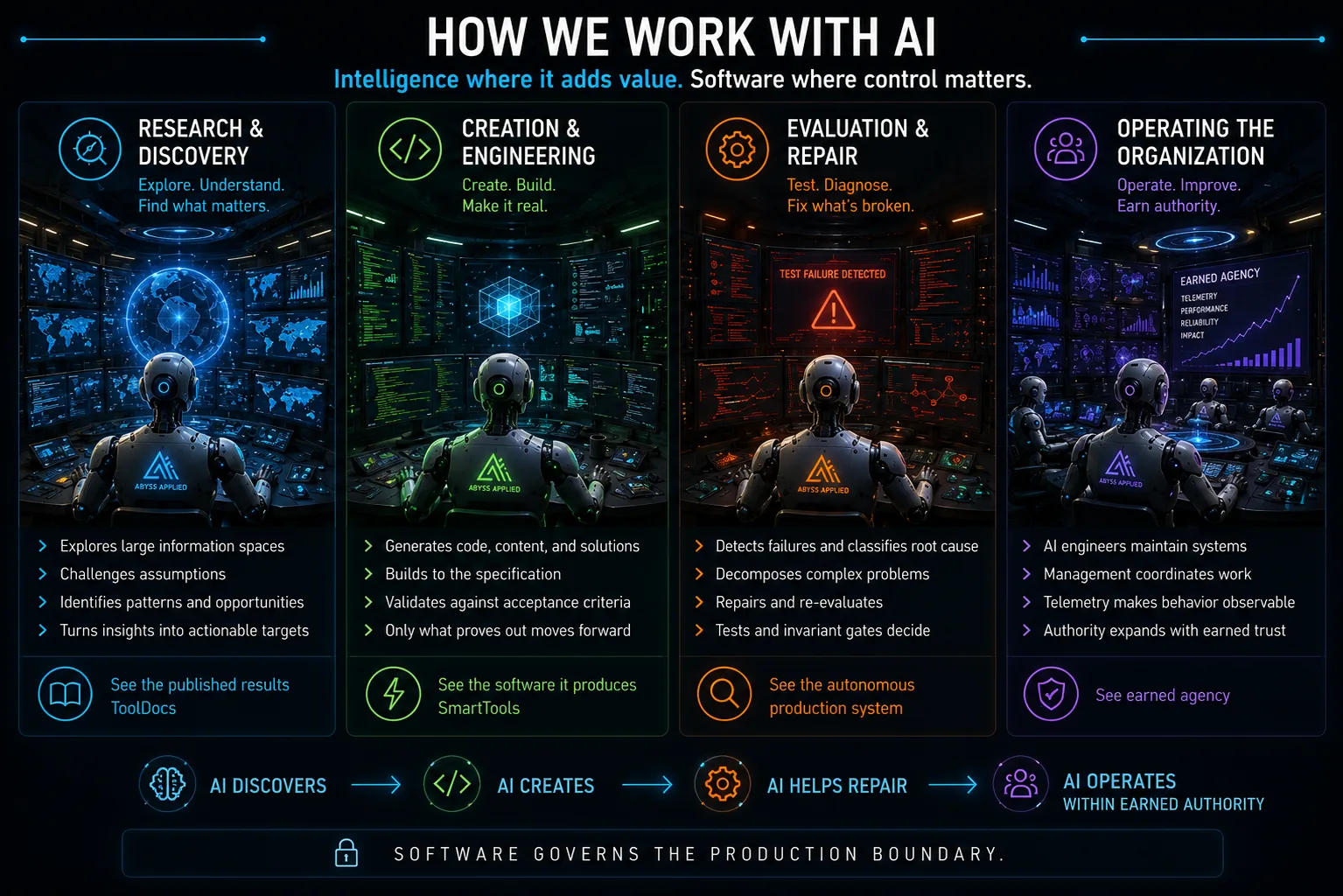
How We Work With AI

Intelligence where it adds value. Software where control matters.

AI participates where work benefits from research, reasoning, creation, evaluation, diagnosis, repair, and adaptive operation.

Specifications, software, tests, invariant gates, telemetry, and accountable human authority determine what moves forward and how much autonomy the system receives.

Engineering decisions require context models do not have. AI assists analysis and execution; the judgment stays ours.

AI is avoided where it increases risk. Where it would add unpredictability, regulatory exposure, or operational complexity that outweighs the benefit, we use conventional approaches instead.

Four panels — research and discovery, creation and engineering, evaluation and repair, and operating the organization — each showing an AI engineer at a different kind of console.

Where We Apply AI

AI discovers → AI creates → AI helps repair → AI operates within earned authority.

Software governs the production boundary.

Research & Discovery

AI explores information, challenges assumptions, identifies opportunities, and helps turn large search spaces into actionable knowledge.

See the published results → ToolDocs Latest: How We Catch a Wrong Number Before It Ships

Evaluation & Repair

When results don't meet the contract, AI helps diagnose where the failure belongs, decompose the problem, and contribute to repair.

Tests and invariant gates determine whether the result moves forward.

Mechanical failures can route to deterministic repair rather than another model call against the same problem.

See the autonomous production system →

Creation & Engineering

AI generates content, software, and candidate solutions where reasoning and creation add value.

Specifications define the target; verification determines what survives.

See the software it produces → SmartTools Latest: Cap Rate Calculator for Real Estate

Operating the Organization

AI engineers maintain and improve their assigned systems.

Management coordinates their work.

Telemetry makes behavior observable, and demonstrated performance determines how much authority they receive.

See earned agency →

Why this is traceable

Engineering intent & traceability

Engineering intent should survive the intelligence that helped create it.

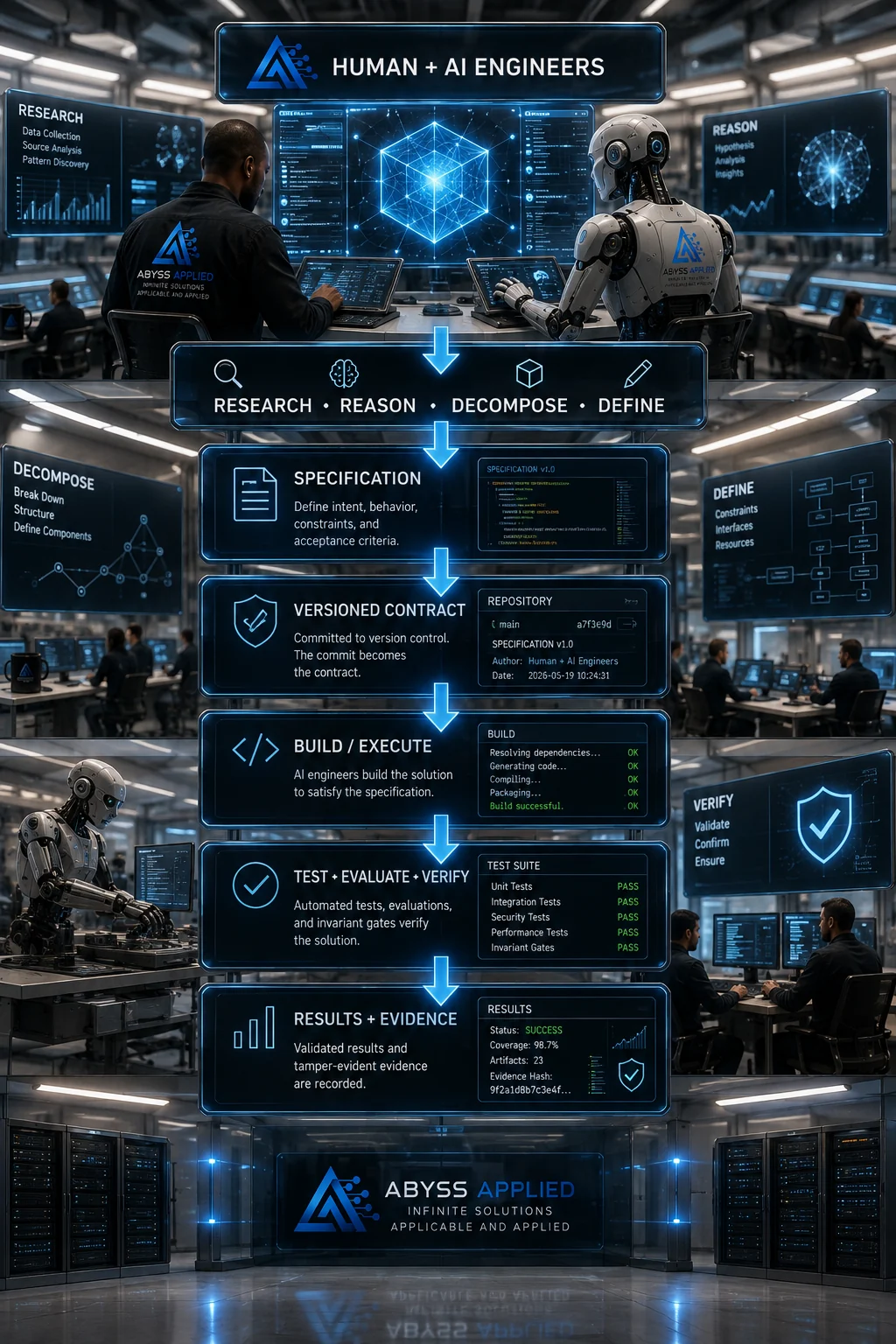
AI models change. Agents restart. Providers change. Context disappears. Engineering intent cannot depend on any of them surviving.

The durable truth belongs in versioned engineering artifacts.

Engineering intent becomes evidence in seven steps: human and AI engineers; research, reason, decompose, define; specification; versioned contract; build and execute; test, evaluate, verify; results and evidence.

Models can change. Engineering intent survives.

No agent owns the truth. The repository does.

A green check isn't proof.

A control can pass while testing the wrong thing. A test can succeed without exercising the behavior it claims to validate.

A guard must be observed failing before it is trusted.

A control must demonstrate that it detects the condition it claims to protect against before its passing state becomes meaningful evidence.

This principle was adopted after repeatedly finding checks that passed for reasons unrelated to their stated claim.

  1. Prove the failure path
  2. Observe the control catch it
  3. Fix the condition
  4. Observe the control pass
  5. Trust the guard

About

Built from environments where failure matters.

Abyss Applied was founded by software architect Marc Alexander, whose career spans defense, intelligence, healthcare, and enterprise systems. Those environments shaped a simple engineering discipline: understand what must be true, build for the conditions the system will actually face, and prove it before trusting it.

Defense and intelligence demanded precision, accountability, security, and evidence. Healthcare added systems serving people directly, where availability, protected information, regulatory boundaries, and operational consequences matter every day.

That experience now informs how Abyss Applied approaches software, data, automation, cloud platforms, regulated systems, and AI. We use intelligence where it adds value, deterministic controls where certainty matters, and evidence to distinguish what works from what merely looks like it does.

We define carefully, build deliberately, prove what we claim, and operate what has earned the right to run.

Have something worth engineering?

Software. Systems. Data. Automation. Cloud. Regulated environments. Applied AI.

  1. Define what must be true
  2. Build it
  3. Prove it
  4. Operate it