Abyss Applied · Research
Beyond the Release Gate
Production AI, the Loss of Behavioral Baselines, and the Economics of Continuous Assurance
Abstract
Enterprise adoption of hosted foundation models introduces a production assurance problem that conventional software development lifecycle (SDLC) controls cannot independently resolve. Release approval establishes a tested configuration, but external model retirements, interface changes, evolving data, and probabilistic behavior can alter the effective system without an enterprise-controlled deployment. This paper distinguishes configuration, behavioral, and operational baselines; develops a two-boundary change-control model; examines rollback limitations and correlated remediation demand; and proposes an economic framework for measuring recurring assurance costs. The central claim is conditional rather than absolute: externally mutable AI dependencies weaken an enterprise's ability to preserve or restore approved behavior, making sustained assurance and experienced engineering judgment integral to total cost of ownership. Figures and financial examples are explicitly illustrative, not empirical estimates.
Keywords: AI operations; SDLC; change control; model drift; model retirement; production reliability; total cost of ownership; engineering governance
1. Introduction: when a release stops being a durable promise
Traditional release engineering is designed to make software changes reviewable, repeatable, and recoverable. A release is not a guarantee that a system can never fail: hardware, operating conditions, third-party services, and requirements can all change. It does, however, define an approved configuration against which deviations can be diagnosed. Google's site reliability engineering literature treats disciplined release engineering, canarying, and rollback as central reliability practices [1].
Hosted generative AI complicates this arrangement. A model may be upgraded or retired by a supplier, a supported parameter may be removed, and a retrieval corpus may evolve, while the application artifact remains unchanged. Anthropic's published model retirement and API parameter policies provide a concrete illustration of upstream lifecycle decisions that downstream applications must accommodate [2]. The relevant risk is not simply that outputs are probabilistic; it is that the conditions governing those outputs may change outside the application owner's release authority.
The resulting thesis is straightforward: deployment authorization and continuing behavioral authorization are distinct controls. An organization can successfully deploy an application and subsequently lose the ability to demonstrate that its behavior still conforms to the approved baseline.
2. Two lifecycles, one incomplete release boundary
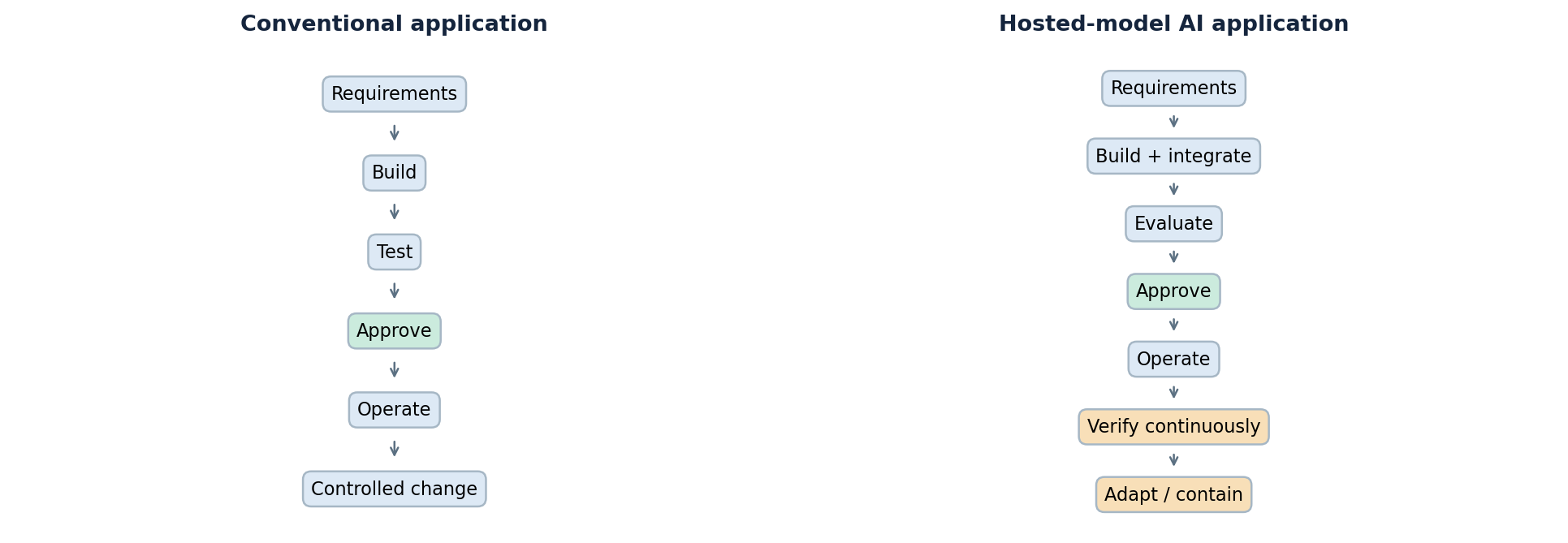
A conventional SDLC moves from requirements through implementation, testing, release approval, and operations, with subsequent changes returned through change control. An AI-dependent SDLC must retain these steps while also monitoring statistical quality, provider compatibility, tool behavior, retrieval integrity, and operating cost. These obligations can be periodic or event-triggered; they need not entail constant human inspection of every request.
2.1 Three different meanings of baseline
| Baseline | Meaning | Limitation |
|---|---|---|
| Configuration | Pinned code, prompts, model identifier, tools, policies, datasets and settings | A provider-controlled endpoint may not preserve all behavior |
| Behavioral | Observed task quality and failure modes on a defined evaluation population | Sampling cannot prove correctness for every future request |
| Operational | Live evidence that quality, latency, security and cost remain acceptable | Requires ongoing observation and a response authority |
This distinction prevents an overstatement: a configuration baseline is still possible in AI, and bounded self-hosted models can provide stronger reproducibility. What is not assured is indefinite behavioral equivalence when critical components are externally mutable.
3. Change control across organizational boundaries
The conventional enterprise change advisory process can authorize modifications to the systems it controls. A provider can independently authorize changes to a hosted model, API, or service policy. The enterprise retains responsibility for its business outcome while lacking veto authority over that supplier change. Thus, contractual notice, compatibility windows, model pinning, and provider commitments are operational controls rather than administrative conveniences.
The practical example is an agent whose requests continue returning HTTP 200 while the provider changes tool-selection behavior. Infrastructure telemetry remains healthy, yet the business outcome regresses. Alternatively, a retired model or rejected request parameter may produce an explicit integration failure. The first is a semantic regression; the second is a contract failure. Both can occur without a new enterprise application release.
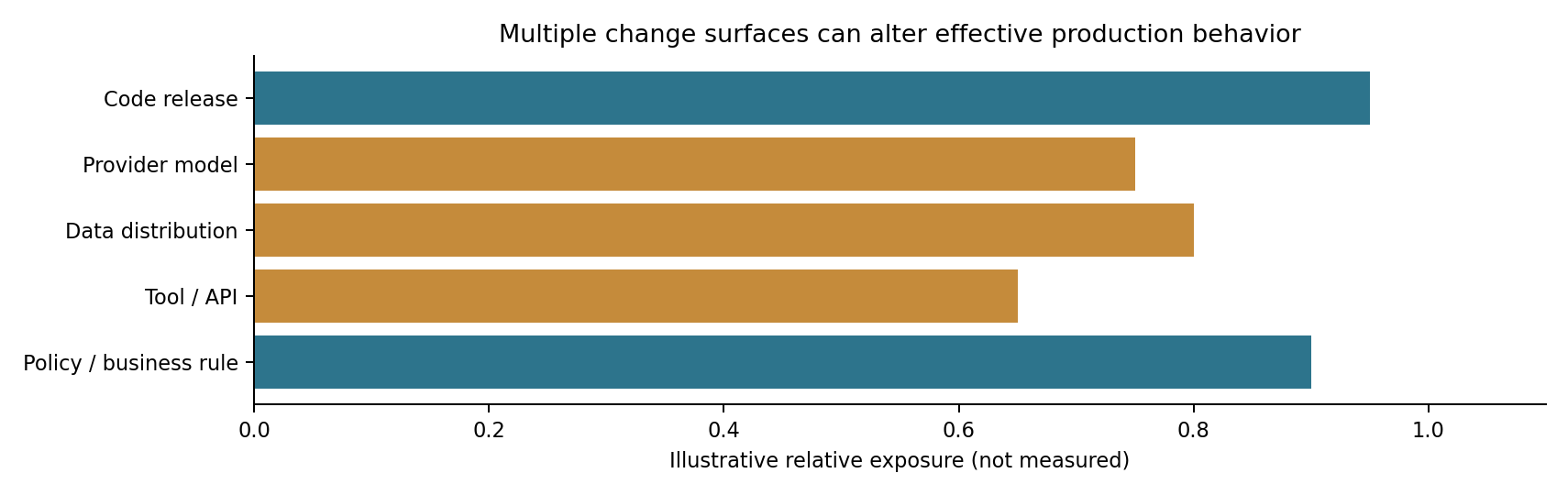
The most difficult condition is correlated change: model behavior, input distributions, and tools can shift over overlapping intervals. Root-cause analysis then requires reconstructing not merely the code deployed but the provider and data state at the time of execution. Logging model IDs, API versions, request parameters, prompt hashes, retrieval versions, and outcome evidence becomes essential.
4. Why conventional rollback can fail
In a conventional rollback, operators restore a previously approved artifact and its compatible dependencies. In a hosted AI application, restoring the application artifact may leave the upstream model unchanged. A retired endpoint may be unavailable; a new endpoint may be semantically incompatible; and a historical output distribution may not be reproducible. Therefore, application rollback does not imply behavioral restoration.
The alternatives are imperfect: fail over to another validated model, constrain the workflow to deterministic logic, reduce autonomy, hold transactions for review, or suspend the affected capability. These are legitimate containment strategies, but they should not be mislabeled as restoration of the original model state.
4.1 A formal expression of the assurance problem
Let effective behavior at time t be Y(t) = F[C(t), M(t), P(t), D(t), T(t), E(t)], where C denotes code, M model behavior, P prompts, D data, T tools, and E environment. A frozen C(t) does not imply a stable Y(t) if any other component changes. An acceptance test estimates whether Y(t) meets defined requirements on a bounded sample; it cannot establish perpetual correctness on an unknown future distribution.
5. Model degradation is not model evolution
Three mechanisms should be separated. Data drift describes changes in the input distribution. Concept drift describes changes in the relationship between inputs and correct outcomes. Provider model evolution describes changes in the supplied model or interface. A more capable successor model can improve general benchmark performance while regressing on a particular application's tool calls, schemas, terminology, or latency constraints.
This distinction matters because retraining is not always the remedy. A hosted LLM application may instead require evaluation updates, prompt changes, retrieval repair, compatibility shims, fallback routing, or a redesigned business boundary. Model-level improvement and application-level reliability must be evaluated independently.
6. Economics: savings at deployment versus cost in service
AI investment proposals commonly quantify reduced implementation time. A complete assessment must also consider inference charges, evaluation labor, monitoring infrastructure, migration work, provider concentration, incident response, and the expected loss associated with incorrect outcomes. The costs may be offset by substantial business value, but that relationship must be measured rather than presumed.
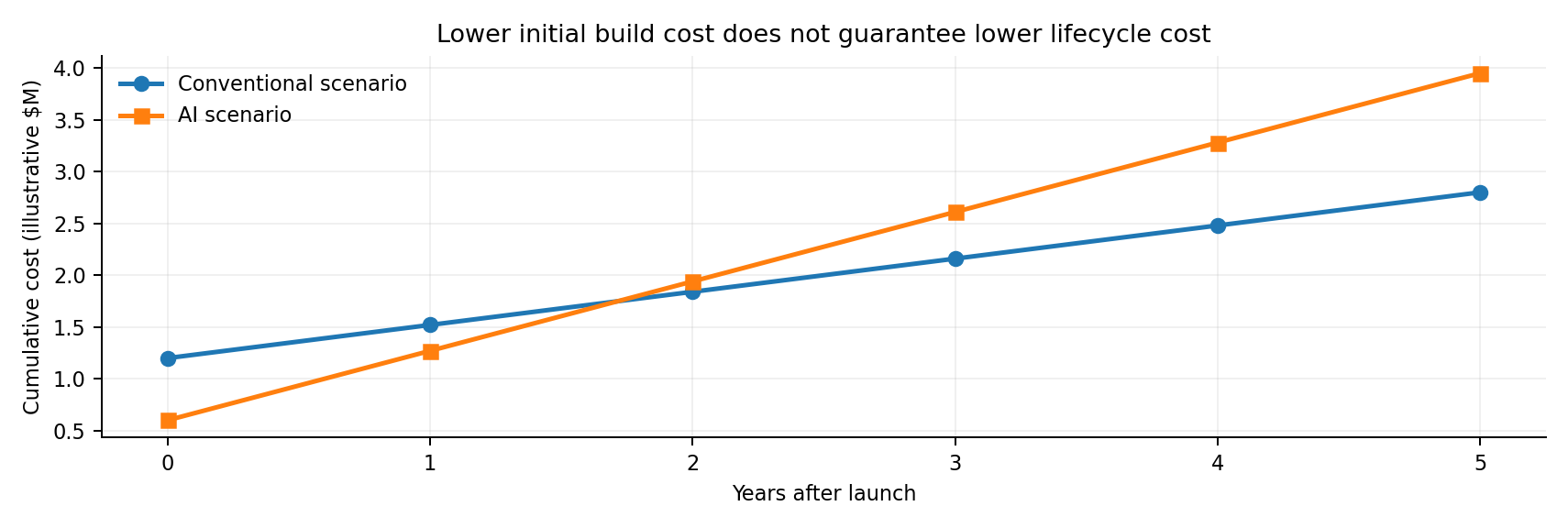
A useful accounting identity is: AI lifecycle cost = initial engineering + conventional O&M + inference + behavioral assurance + adaptation + expected incident loss. Net value then equals discounted business benefit minus discounted lifecycle cost.
An honest comparison uses the same workload, quality threshold, time horizon, and business outcome for both conventional and AI alternatives.
A critical scaling hazard is shared-provider exposure. If 200 workflows rely on one model family, a single upstream change may trigger evaluation across all 200. This does not prove costs increase linearly with workflow count: reusable test harnesses and centralized gateways can reduce marginal effort. It does mean that incident capacity must consider correlated failures, not merely independent average workloads.
7. Engineering judgment as a production control
Code generation and production diagnosis are not equivalent skills. Senior engineers contribute architectural memory, failure isolation, risk tradeoffs, restoration strategy, and the ability to recognize when technically successful execution produces a wrong business outcome. AI assistants can support these tasks, but they do not automatically supply independent ground truth or accountable authorization.
A staffing strategy that lowers experienced engineering capacity while expanding model-dependent workflows may reduce visible development expense while increasing recovery time and operational fragility. This is a testable hypothesis, not a demonstrated universal industry trend. Evidence would require longitudinal staffing, incident, recovery, and cost data controlling for organizational size and deployment complexity.
8. A control architecture for sustainable adoption
The proposed architecture has two authorization decisions: (1) permission to deploy after conventional tests and task-specific evaluations, and (2) permission to continue operating based on ongoing quality, security, and cost evidence. For high-consequence actions, probabilistic components should generally interpret or recommend while separately governed mechanisms authorize and commit irreversible actions.
| Control | Minimum evidence | Responsible owner |
|---|---|---|
| Release gate | Version manifest, contract tests, risk assessment, evaluation results | Engineering + risk authority |
| Continuous assurance | Outcome sampling, drift indicators, tool traces, budget alarms | Production reliability team |
| Provider-change response | Notice tracking, regression suite, alternate path, migration window | Platform + vendor management |
| Containment | Kill switch, deterministic fallback, human escalation, rollback limits | Incident commander + business owner |
| Periodic reauthorization | Evidence of maintained business quality and acceptable residual risk | Accountable business executive |
These controls should be proportional to consequence. A low-risk drafting assistant does not need the same validation frequency or human approval as a system that influences medical coverage, access decisions, or financial transactions. Nor should governance be confused with control: monitoring and reporting do not confer the ability to reverse an upstream provider change.
9. Research agenda and falsifiable propositions
- P1
- Hosted-model applications with higher upstream change frequency incur greater regression-validation effort, holding application scope constant.
- P2
- Organizations with stronger dependency pinning, fallback paths, and evaluation coverage experience lower time to safe containment after provider changes.
- P3
- Reduced senior production-engineering capacity predicts longer semantic-incident diagnosis time after controlling for workload complexity.
- P4
- AI projects evaluated over multiyear horizons exhibit different return-on-investment rankings than projects evaluated solely at initial deployment.
Testing these propositions requires provider change logs, incident timelines, model and prompt version histories, actual inference bills, evaluation labor, and outcome-based quality measures. The present paper does not claim to have collected those datasets.
10. Conclusion
The central risk of hosted AI is not that probabilistic software cannot be deployed responsibly. It is that an enterprise may approve a system whose effective behavior can change outside its release process and whose prior behavior cannot always be restored. This turns behavioral assurance into a recurring production responsibility and creates an enduring question of authority: who accepted the risk, who can contain the failure, and who funds the work required to keep the system trustworthy?
The appropriate response is neither blanket rejection nor unconditional adoption. It is to treat AI as a distinct operational dependency class, preserve accountable engineering judgment, restrict autonomy where guarantees are necessary, and evaluate economic benefit over the full operating lifetime.
The measure of success is not how cheaply software was produced, but how reliably and economically the business outcome can be sustained.
References and source notes
- Google, Site Reliability Engineering: Release Engineering. https://sre.google/resources/book-update/release-engineering/
- Anthropic, Claude Platform Documentation: Model Deprecations (accessed November 2026). https://platform.claude.com/docs/en/about-claude/model-deprecations
- NIST, AI Risk Management Framework (AI RMF 1.0), NIST AI 100-1 (2023). https://nvlpubs.nist.gov/nistpubs/ai/NIST.AI.100-1.pdf
- NIST, Artificial Intelligence Risk Management Framework: Generative AI Profile, NIST AI 600-1 (2024). https://nvlpubs.nist.gov/nistpubs/ai/NIST.AI.600-1.pdf
- Sculley et al., Hidden Technical Debt in Machine Learning Systems, NeurIPS (2015). https://papers.nips.cc/paper/5656-hidden-technical-debt-in-machine-learning-systems
- Breck et al., The ML Test Score: A Rubric for ML Production Readiness and Technical Debt Reduction (2017). https://research.google/pubs/the-ml-test-score-a-rubric-for-ml-production-readiness-and-technical-debt-reduction/
Methodological note. This is a conceptual position paper, not an original empirical study or systematic review. All charts are explanatory illustrations. Provider documentation is subject to future revision.